
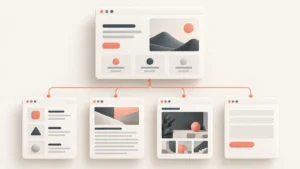
What Pages Does Your Business Website Really Need? Give Every Page a Clear Purpose.
· Sasha
A good website is not about how many pages it has. It's about helping people understand what you offer, answer their questions and find the right next step.
Picture walking into a store. Products, signs and staff are everywhere, yet nothing is clearly organized. You don't know where to start, how to compare your options or who to ask for help.
A website can create the same experience.
It may look polished and contain plenty of information. But if everything is competing for attention, visitors have to work too hard to understand what you do.
Sometimes the problem isn't that your website needs more pages. It's that its existing pages don't have clear jobs to do.
Let's look at the different types of pages a business might need, when they make sense and how thoughtful organization supports both people and search visibility.
A website is more than a list of pages
When planning a site, it's tempting to start with a checklist: Home, About, Services, Blog and Contact.
Those pages might be useful, but the better starting point is a business question: What should this website help us achieve?
A company looking for qualified inquiries needs a different journey from a professional booking appointments or a store selling products online. Even two businesses in the same industry may need very different structures.
Before adding another page, ask who it is for, what question it answers and which next step would genuinely help that visitor.
Your homepage: explain your business and help people find their way
The homepage is usually the main entry point to your website.
Its job isn't to include everything you know about your company. It should help visitors quickly understand what you do, who you help and where to go next.
For example, a development studio offering e-commerce websites and custom software can introduce both services on its homepage and link to more detailed pages.
When it's useful: for most business websites that need to present a brand and offer different paths.
When it's not helpful to overload it: when the homepage repeats every service detail, FAQ, case study and article. A homepage should guide people, not replace the rest of the site.
Service pages: answer questions before people have to ask
A service page explains a specific solution in enough detail for someone to evaluate it.
Simply listing “web development”, “website maintenance” or “SEO” rarely tells a potential client what they actually need to know.
A useful service page makes the problem, ideal customer, scope, process and next step clear.
When it makes sense: when the service has a distinct offer and enough meaningful information to deserve its own page.
When it doesn't: when multiple pages are almost identical apart from a few changed keywords. More URLs do not automatically mean more business opportunities.
Industry pages: speak to specific needs when there is a real difference
An industry page, sometimes called a vertical, addresses a particular sector, audience or use case.
Think of an online appointment booking platform. It may have a general product page plus more focused information for dental practices, beauty salons or independent professionals.
Those audiences might have different questions about team schedules, reminders, capacity or day-to-day operations.
An industry page is useful only when it offers genuinely relevant detail.
When it makes sense: when different audiences need different examples, features, explanations or buying criteria.
When it doesn't: when a page merely swaps one industry name for another while repeating the same generic copy.
Your blog: answer the questions people ask before they're ready to buy
Not everyone arrives at your site ready to hire or purchase.
Some people want to understand why their website is slow, when they should redesign it or how SEO differs from GEO.
A blog can help answer those questions, share expertise and support people throughout their decision-making process.
A helpful article doesn't have to become a sales pitch. It can provide a real answer and then, where relevant, point readers toward a service or case study.
When it makes sense: when you understand the questions your audience asks and can publish useful, maintainable content.
When it doesn't: when the blog becomes a collection of generic posts unrelated to your customers or business goals.
Case studies: demonstrate your work rather than just describe it
A service page tells people what you offer. A case study shows the starting problem, the decisions made, the work delivered and the outcomes that can actually be measured.
Credibility comes from accuracy. Separate what was implemented from what was observed, and don't present assumptions as proven results. Our Naturalia organic strategy case study documents decisions, sources and reporting periods without promising the same outcomes for other projects.
When it makes sense: when you have a documented project, permission to share it and evidence worth showing.
When it doesn't: when the story relies on invented testimonials or unverifiable outcomes.
Landing pages and contact pages: make the next step easier
A landing page focuses on a particular offer or campaign. It might invite visitors to request a demo, explore a specific solution or ask for a quote.
Its journey is often more focused than a homepage because it has one primary objective.
A contact page should make it easy to get in touch without unnecessary friction. If a website gets traffic but few inquiries, examine how clearly the offer comes across and how easy it is to take that next step.
When a landing page makes sense: when the offer, audience and goal are sufficiently specific.
When it doesn't: when it duplicates an existing service page without delivering a distinct experience.
How you organize information within each page matters, too
Choosing the right pages is only half the job. The information on those pages needs a clear structure.
Need to make that journey clearer? Our custom web development service plans structure and content around the problem your business needs to solve.
Think of a book: it has a title, chapters, sections and paragraphs. If every line looked equally important, reading it would take more effort.
A well-organized web page works in a similar way:
- The main heading makes the page's topic clear.
- Section headings help readers scan its key ideas.
- Smaller subsections explore more specific questions.
- Paragraphs provide explanations, examples and answers.
- Highlighted phrases draw attention without turning every sentence into a heading.
Developers translate that structure into the appropriate underlying HTML elements. You don't need to learn the code to understand the principle: visual emphasis and content hierarchy should support each other.
Not every oversized text element is a page heading, and changing a text element's formatting doesn't make search engines or AI systems ignore its words.
Breadcrumbs: simple signs that show where you are
You may have seen a navigation trail like this:
Home > Services > E-commerce Development
These are called breadcrumbs. They show a page's place in the website and make it easier to move back to a broader section.
They can be particularly useful on larger websites with several levels of content, but they should reflect a real, logical structure—not add complexity for its own sake.
Give every important topic a clear home
Imagine five pages on a website all trying to explain the same development service. They overlap, repeat similar claims and leave visitors unsure where to look.
Before creating another page, decide which page should be the main reference for that topic and how the supporting pages differ.
Some teams call this topic ownership: giving each important topic or search intent a clear primary destination.
That doesn't mean a topic can only be mentioned once. One page can explain a service, another can answer a specific question and a third can demonstrate a real project. The pages support each other instead of merely repeating the same content.
When multiple URLs have duplicate or very similar content, technical signals such as canonical URLs can indicate a preferred version. They are not a substitute for a clear content strategy, and Google may choose a different canonical. It also helps to review which pages should represent your business on Google.
Help visitors move naturally between related pages
Someone might discover an article about when to redesign a website, explore a related service and then look at a case study before making contact.
Someone else may start on a service page or homepage. There is no single journey that works for every visitor.
What matters is connecting relevant pages with useful links and making the next step appropriate to each person's needs.
That's why website architecture, content and internal links between related pages should be planned together.
What does this have to do with SEO and GEO?
SEO focuses on improving organic visibility in search engines. GEO looks at how brands and information may be discovered, interpreted or used in AI-powered search experiences.
A well-structured website supports both goals by making information easier to find, navigate and understand.
Google's guidance also emphasizes helpful content, meaningful internal links, accessible text and a good experience for users. Those SEO foundations remain relevant to Google's AI search features.
That said, good structure doesn't guarantee top rankings or recommendations from ChatGPT. It is one part of a broader effort involving content quality, technical implementation and measurement.
So, how many pages does your business actually need?
As many as it needs to explain your offer and help visitors make decisions. There is no universal minimum and no prize for publishing the most URLs.
Before creating a new page, answer three questions:
- Who is it for? Who needs this information?
- What does it solve? What question or decision isn't already clearly covered?
- What should it achieve? Education, comparison, credibility or a qualified inquiry?
If those answers aren't clear, revisiting the structure may be more useful than adding new pages.
Frequently asked questions
Does every business need a blog?
No. A blog is worthwhile when you have a relevant content strategy and can maintain it. For some businesses, strong service pages and credible case studies are the higher priority.
Should every service have its own page?
Not necessarily. Separate pages are useful when the offers and customer questions are meaningfully different. Closely related services can often share a page without sacrificing clarity.
What's the difference between a service page and an industry page?
A service page explains what you offer. An industry page shows how that offer addresses the specific needs of a sector or audience—when those differences genuinely matter.
Do breadcrumbs help SEO?
They can improve navigation and clarify a page's place in the site hierarchy. They do not guarantee better search rankings.
Will a well-organized website appear in AI-generated answers?
Clear, relevant and accessible information can help systems interpret your content, but no page structure guarantees an AI citation or recommendation.
A successful website isn't measured by its page count
It's measured by how well it guides, informs, builds trust and supports real business goals.
When every page has a clear purpose, your website stops feeling like a collection of screens and starts working as a connected experience.
We don't build pages just to add pages. We plan each one to do a job.
Every page of your website should have a purpose.
At Tu WebMaster, we build web architecture and SEO and GEO strategies around clear goals and measurable outcomes.